
OCMR Investment Perspectives 2.1
Why Buffered ETFs Require Ongoing Analysis and Monitoring

Even “identical” buffered ETFs can deliver dramatically different results due to nothing more than the luck of their reset dates.
FJUL and FAUG are two adjacent monthly slices within the popular First Trust BUFR laddered ETF. Both offer the same 10% buffer width, the same cap methodology, and the same 12-month outcome period. They are managed identically and completely passively — there is no active management involved. The only difference is that FJUL resets on the third Friday of July, while FAUG resets one month later in August. Yet over the past five years, this one-month offset produced a cumulative return gap of 18.4 percentage points.
Cumulative Total Return: FJUL vs. FAUG
April 2021 – April 18, 2026
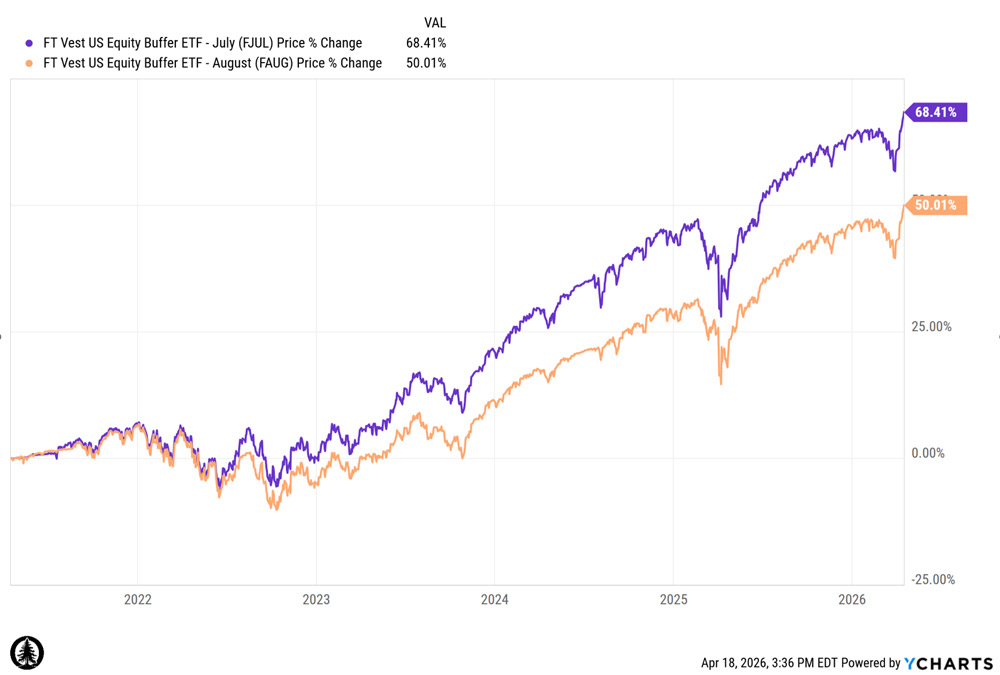
FJUL (July reset): +68.41%
FAUG (August reset): +50.01% Differential: +18.40 percentage points
This performance gap is not the result of skill. It is pure path dependency — the consequence of different options pricing conditions (implied volatility, skew, interest rates, and the exact level of the S&P 500) on their respective reset dates.
Most investors would feel significant regret if they had chosen the underperformer and satisfaction if they had picked the winner. Yet few realize how easily this timing lottery can occur when selecting individual buffered ETFs.
Why This Happens
At each reset, the ETF constructs a new package of S&P 500 index options that defines the buffer and cap for the coming 12 months. A shift of just one month can meaningfully change the pricing environment, especially during periods of elevated volatility or market stress. Because these products are rules-based and passively managed, the resulting return differences stem entirely from market path and reset timing — not from any manager decisions.
To illustrate that FAUG is not a perpetual underperformer, the table below shows performance by calendar year.
Annual Return Breakdown
| Year | FJUL Return | FAUG Return | FJUL Advantage |
|---|---|---|---|
| 2022 | -6.25% | -10.52% | +4.27% |
| 2023 | +13.75% | +4.90% | +8.85% |
| 2024 | +33.83% | +20.16% | +13.67% |
| 2025 | +14.19% | +13.77% | +0.42% |
| Cumulative (Apr 2021 - Apr 2026) | +68.41% | +50.01% | +18.40% |
The widest gaps occurred during the volatile 2022-2024 period, when differences in reset-date options pricing had the greatest impact. By 2025 the performance had largely converged, confirming that FAUG is far from a perpetual laggard.
Implications for Investors
This example highlights an important reality: buffered ETFs are passive in structure but highly path-dependent in outcome. Selecting individual names (rather than a full ladder like BUFR) exposes investors to reset-timing risk that can compound into meaningful performance dispersion over time.
At BufferLABS (the DBA of Ogard Capital Market Research LLC), we help investors navigate this challenge. Our approach evaluates each buffered ETF in real time using its actual current options holdings. The ADOPT model dynamically incorporates market path and options pricing factors to assess the relative probability of future under- or outperformance.
Investors who hold individual buffered ETFs — rather than a diversified ladder — can benefit from a more comprehensive analytic framework. Ongoing monitoring helps avoid unintended exposure to ETFs that, at any given time, may have a higher likelihood of lagging their peers due to reset-date dynamics.
Disclosures
This material is for informational and educational purposes only and does not constitute investment advice, a recommendation, or an offer to buy or sell any security. The views expressed are general in nature and are not tailored to any specific investor’s financial situation, objectives, or risk tolerance. Buffered ETFs involve risks, including loss of principal, and may not provide the intended buffer or cap outcomes if shares are bought or sold prior to the end of the outcome period. Outcomes are dependent on market conditions and the timing of investment relative to the ETF’s reset date. Any references to models, analytics, or probability assessments are based on assumptions and estimates that may not prove to be accurate. There is no guarantee that any model or analysis will achieve its intended results. Data is believed to be reliable but is not guaranteed as to accuracy or completeness. BufferLABS is a DBA of Ogard Capital Market Research LLC is an SEC registered investment advisor. Past performance is not indicative of future results. All data sourced from YCharts as of April 18, 2026.
Comments