BufferLABS US Equity Dynamic Buffer ETF (BFLB) First Quarter 2026 Market and Fund Commentary
Market Review
Large Capitalization US equities, as measured by the S&P 500 Index, were down during the quarter due to: 1) the “weight” of high stock valuations, 2) uncertainty related to inflation and oil prices, and 3) the US conflict with Iran, among other things. Other broad-based Large Cap US equity indices were also down. In total, these factors tipped the markets into a sell-off at the beginning of March. While a relief rally punctuated the end of quarter returns, it remains to be seen whether the selling pressures have ended. There is a great deal of uncertainty pervading the “zeitgeist” of the average investor, as evidenced by the currently elevated VIX (a measure of stock market volatility and a proxy for current market risk). Here is a picture of the VIX index below:
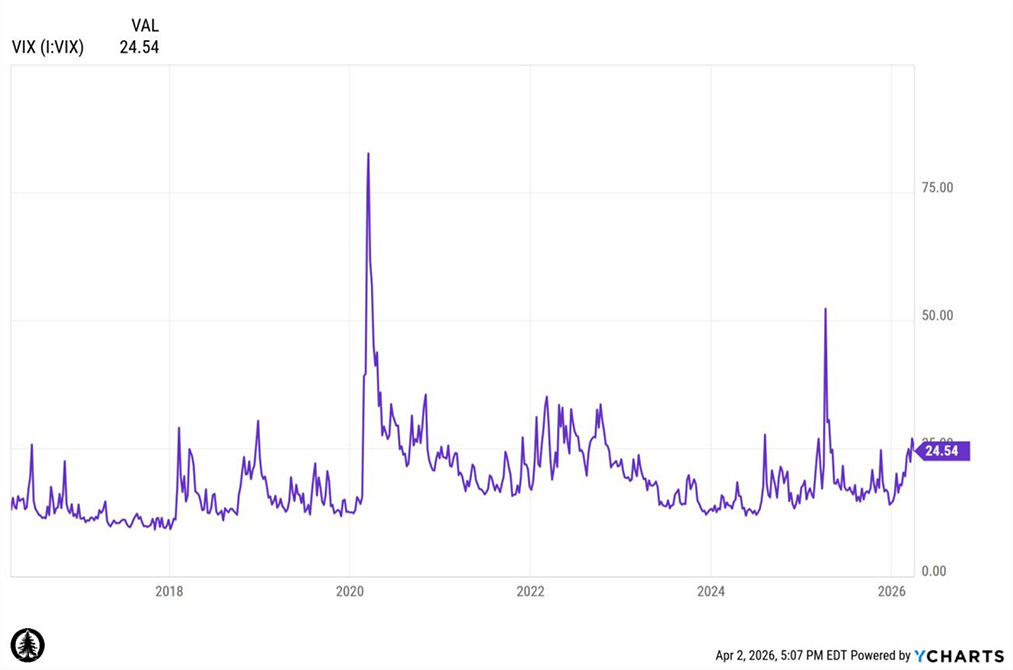
We will learn over the course of the next several months whether the current risk episode grows into a more material risk event, or it recedes into memory and is chalked up as another “nothing to see here” moment.
BFLB Review
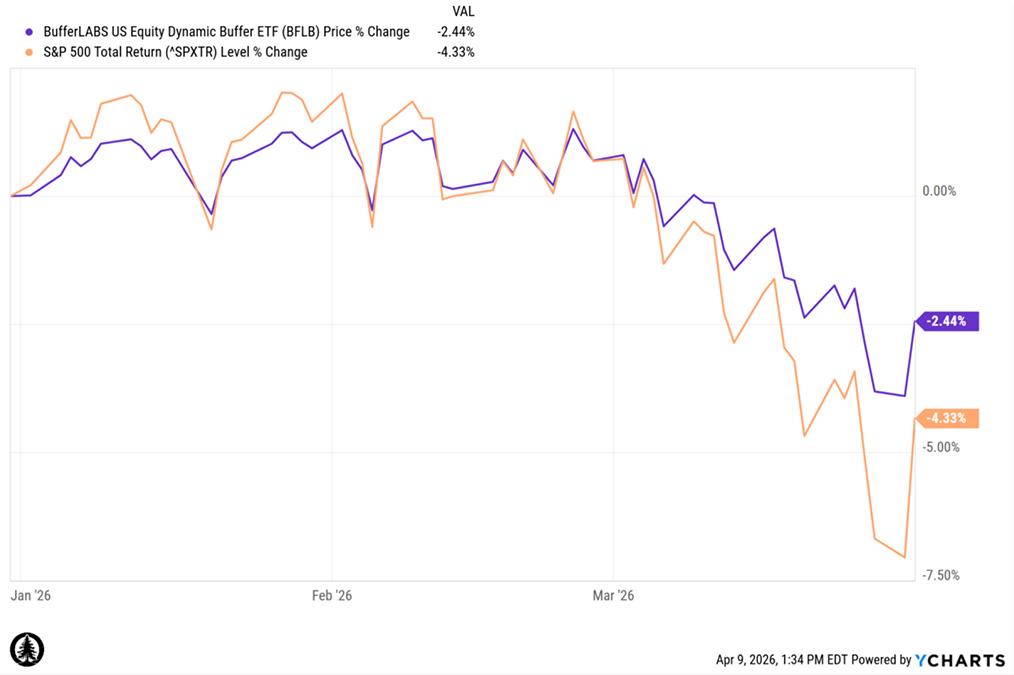
The fund lived up to its purpose of providing market exposure with hedged downside management. During the quarter, and as can be seen from the chart below, the S&P 500 Index returned -4.33%, while BFLB returned (as measured by the fund’s NAV) -2.44% (net of fees), outperforming the index by 219 basis points, and reducing the drawdown by almost 50% in Q1 2026. (A drawdown is a percentage drop from the market’s prior all-time high.) We are generally satisfied with these results as the fund successfully achieved its objective of curtailing downside risk.
The performance data quoted represents past performance and does not guarantee future results.
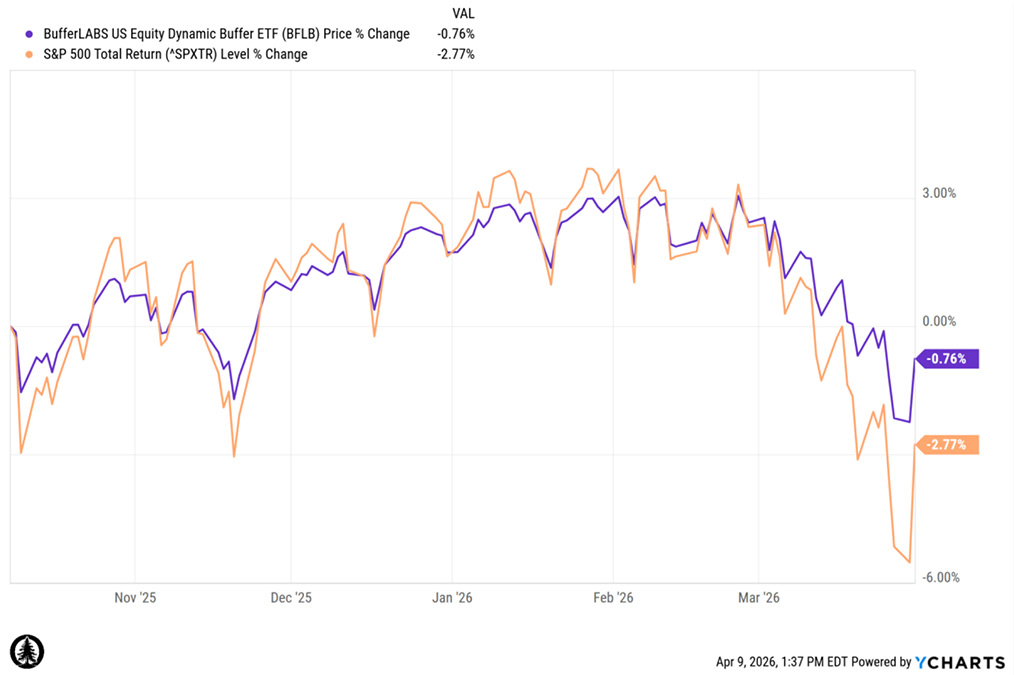
Since the inception of BFLB on October 7, 2025, its performance has also been generally in line with the fund’s objectives relative to the underlying index’s path. At the end of the quarter, the fund’s NAV performance is ahead of the index by 2% net of fees (-0.76% for BFLB versus -2.77% for the index.) Below is the chart:
The performance data quoted represents past performance and does not guarantee future results.
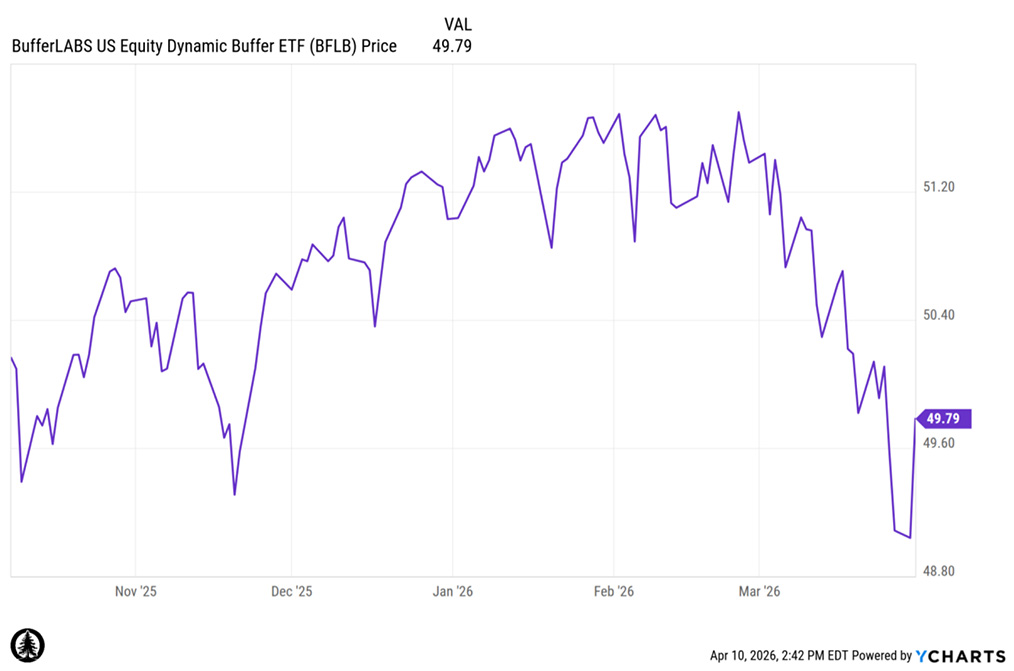
The fund was launched on October 7, 2025 with a Net Asset Value (NAV) of $50.00 per share. On March 31, 2026, the fund’s NAV was $49.79. Here below is the fund’s daily NAV since inception:
The performance data quoted represents past performance and does not guarantee future results.
The performance data quoted represents past performance and is no guarantee of future results. Investment return and principal value of an investment will fluctuate so that an investor’s shares, when redeemed, may be worth more or less than their original cost. Current performance may be lower or higher than the performance data quoted. The Fund is new and therefore does not have a performance history for a full calendar year as of the most recent quarter end.
Quarter End Performance
As of Date: 03/31/2026
| Fund Ticker | Type | YTD | 1 Month | 3 Month | 6 Month | 1 Year | 3 Year | 5 Year | 10 Year | Since Inception | Inception Date |
|---|---|---|---|---|---|---|---|---|---|---|---|
| BFLB | MKT | -2.44 | -3.11% | -2.44% | -0.43% | 10/07/2025 | |||||
| BFLB | NAV | -2.44 | -3.14% | -2.44% | -0.44% | 10/07/2025 |
The performance data quoted represents past performance and is no guarantee of future results. Investment return and principal value of an investment will fluctuate so that an investor’s shares, when redeemed, may be worth more or less than their original cost. Current performance may be lower or higher than the performance data quoted. The Fund is new and therefore does not have a performance history for a full calendar year as of the most recent quarter end.
Market price returns are based upon the closing composite market price and do not represent the returns you would receive if you traded shares at other times. Returns are average annualized total returns, except those for periods of less than one year, which are cumulative. YTD is year-to-date and ITD is inception-to-date.
NAV return represents the closing price of the underlying securities.
Performance results net of .79% total expense ratio. For performance data current to the most recent month end, please call 1.253.777.8784 or bflbetf.com.
The fund is presently comfortably inside its current buffer range, meaning there remains ample downside risk management remaining in the current buffer structure. The fund will reset its buffer position in the second quarter, and market conditions will determine the features of the replacement hedge (meaning the maturity of the next hedge, as well as the buffer level start, total buffer depth, and the upside cap). In the meantime, the existing options positions provide the portfolio with the exposure we desire to achieve our upside participation and downside management objectives.
Disclosures
The Fund’s investment objectives, risks, charges, and expenses must be considered carefully before investing. This and other important information is contained in the prospectus, which may be obtained by following the links Prospectus and Summary Prospectus or by calling +1.253.777.8784. Please read the prospectus carefully before investing.
The Fund is actively managed and is subject to the risk that the strategy may not produce the intended results. The Fund is new and has a limited operating history to evaluate.
There is no assurance that the fund will achieve its investment objective or will be successful in capturing more upside or providing downside protection. The Fund may not be suitable for all investors. Investors should continue to review their investment objectives and risk tolerance periodically.
Buffer and Cap Risks. There can be no guarantee that the Fund will be successful in its strategy to buffer against the Underlying ETF’s losses. Each investment of the Fund with respect to the Underlying ETF seeks to deliver returns that match those of the Underlying ETF (up to the Cap), while typically limiting downside losses, if the Fund’s investment is held until the applicable options expire. Additionally, because of the Cap, the Fund’s investments may underperform those of funds that do not use a Buffer and Cap structure. Because the amount of the Buffer and the corresponding Cap with respect to the Underlying ETF are determined separately each time the Fund adds exposure to the Underlying ETF and each will vary depending on BufferLABS’ view of market conditions and the cost of the available options contracts, Shares will not reflect a particular fixed overall Buffer or Cap for any particular period, and consequently, investors in the Fund will not receive the protection of any particular fixed Buffer level (or be limited by any particular Cap) regardless of when they purchase or sell Shares. The Fund does not provide principal protection, and an investor may experience significant losses on its investment, including loss of its entire investment.
Management Risk. The Fund is actively managed and may not meet its investment objective based on the Adviser’s, BufferLABS’, Arin’s or the portfolio managers’ success or failure to implement investment strategies for the Fund. The success of the Fund’s investment program depends largely on the investment techniques and risk analyses applied by the Adviser, BufferLABS, Arin, and the portfolio managers and the skill of the Adviser, BufferLABS, Arin, and/or portfolio managers in evaluating, selecting, and monitoring the Fund’s assets. The Fund could experience losses (realized and unrealized) if the judgment of the Adviser, BufferLABS, Arin or portfolio managers about markets or sectors or the attractiveness of particular investments made for the Fund’s portfolio prove to be incorrect. It is possible the investment techniques and risk analyses employed on behalf of the Fund will not produce the desired results. Absent unusual circumstances (e.g., the Adviser determines a different security has higher liquidity but offers a similar investment profile as a recommended security), the Adviser will generally follow BufferLABS’ investment recommendations to buy, hold, and sell securities and financial instruments.
New Sub-Advisor Risk. BufferLABS has no experience with managing an ETF, which may limit its effectiveness.
Options Risk. Writing option contracts can result in losses that exceed the seller’s initial investment and may lead to additional turnover and higher tax liability. Buying options is a speculative activity and entails greater than ordinary investment risks. Many factors influence the value of an option, including the price of the underlying asset, the exercise price, the time to expiration, the interest rates, and the dividend on the underlying asset. The buyer’s success in implementing an option buying strategy may depend on an ability to predict movements in interest rates. There is no assurance that a liquid market will exist when the buyer seeks to close out any option position. When an option is purchased to hedge against price movements in an underlying asset, the price of the option may move more or less than the price of the underlying asset.
Special Tax Risk. The Fund intends to qualify as a “regulated investment company” (“RIC”), however, the federal income tax treatment of certain aspects of the proposed operations of the Fund are not entirely clear. This includes the tax aspects of the Fund’s options strategy, its hedging strategy, the possible application of the “straddle” rules, and various loss limitation provisions of the Internal Revenue Code of 1986, as amended. If, in any year, the Fund fails to qualify as a RIC under the applicable tax laws, the Fund would be taxed as an ordinary corporation. Certain options on an ETF may not qualify as “Section 1256 contracts” under Section 1256 of the Code, and disposition of such options will likely result in short-term or long-term capital gains or losses depending on the holding period.
Active Trading Risk. The Fund expects to engage in active and frequent trading of its portfolio securities and its portfolio turnover rate may exceed 100%. A higher rate of portfolio turnover increases transaction costs, which may negatively affect the Fund’s return. In addition, a high rate of portfolio turnover may result in substantial short-term gains, which may have adverse tax consequences for Fund shareholders.
Sector Risk. To the extent the Fund invests more heavily in particular sectors of the economy, its performance will be especially sensitive to developments that significantly affect those sectors.
New Fund Risk. The Fund is a recently organized investment company with no operating history. As a result, prospective investors have no track record or history on which to base their investment decision. There can be no assurance that the Fund will grow to or maintain an economically viable size.
Large Capitalization Companies Risk. Large-capitalization companies may trail the returns of the overall stock market. Large capitalization stocks tend to go through cycles of doing better – or worse – than the stock market in general. These periods have, in the past, lasted for as long as several years.
Risk of Investing in the U.S. Certain changes in the U.S. economy, such as when the U.S. economy weakens or when its financial markets decline, may have an adverse effect on the securities to which the Fund has exposure.
Non-Diversification Risk. Because the Fund is non-diversified, it may be more sensitive to economic, business, political or other changes affecting individual issuers or investments than a diversified fund, which may result in greater fluctuation in the value of the Shares and greater risk of loss.
Equity Investing Risk. An investment in the Fund involves risks similar to those of investing in any fund holding or exposed to equity securities, such as market fluctuations, changes in interest rates and perceived trends in stock prices. The values of equity securities could decline generally or could underperform other investments. In addition, securities may decline in value due to factors affecting a specific issuer, market or securities markets generally.
An investment in the Fund involves risk, including possible loss of principal. Exchange-traded funds (ETFs) trade like stocks, are subject to investment risk, fluctuate in market value and may trade at prices above or below the ETF’s net asset value (NAV), and are not individually redeemable directly with the ETF. Brokerage commissions and ETF expenses will reduce returns. ETFs are subject to specific risks, depending on the nature of the underlying strategy of the Fund, which should be considered carefully when making investment decisions. For a complete description of the Fund’s principal investment risks, please refer to the prospectus.
Shares of the Funds Are Not FDIC Insured, May Lose Value, and Have No Bank Guarantee.
The Fund is distributed by PINE Distributors LLC. The Fund’s investment adviser is Empowered Funds, LLC, which is doing business as ETF Architect. Ogard Capital Market Research, LLC (“BufferLABS”) and Arin Risk Advisor, LLC (“Arin”) serve as the Sub-advisers to the Fund. PINE Distributors LLC is not affiliated with ETF Architect, Ogard Capital Market Research LLC, and Arin Risk Advisors, LLC.
Comments